
Trading Education
Margin, Leverage and Margin Calls: What Every Trader Must Understand
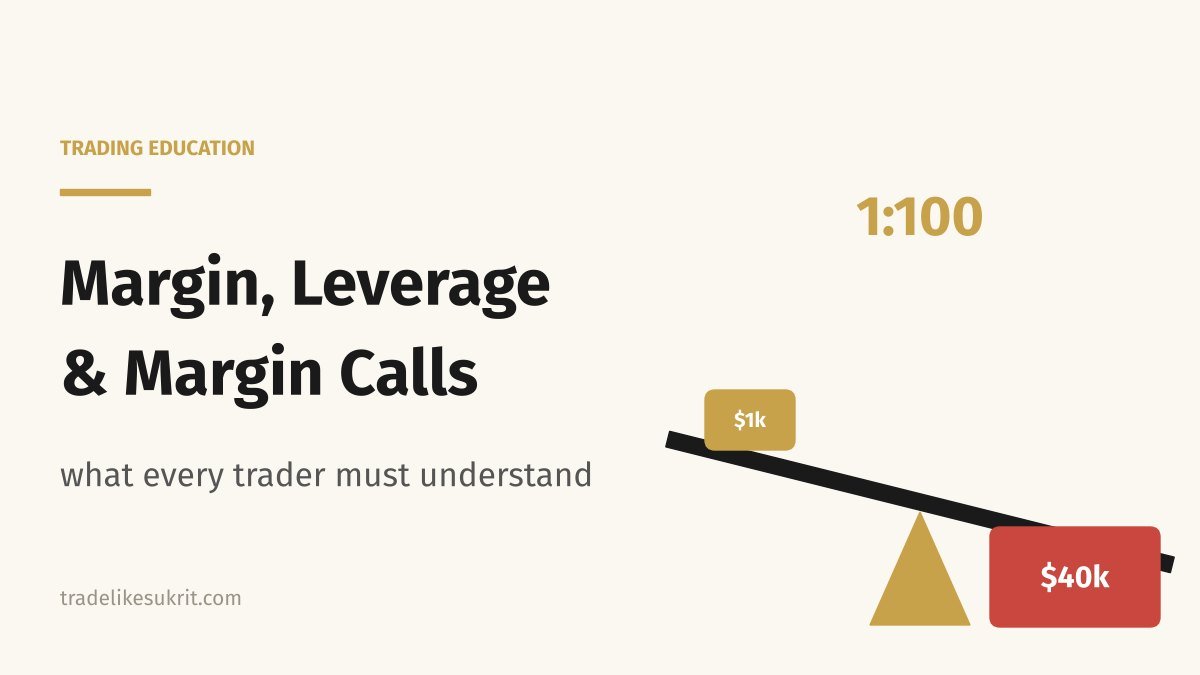
Leverage is the reason a trader with $1,000 can control a $40,000 position in gold. It is also the reason that same trader can be closed out by a price move of just 2%.
Margin, leverage and margin calls are not advanced topics. They decide how much you can trade, how much a move costs you, and when your broker steps in and closes your positions for you. Misunderstanding them is one of the fastest ways to lose an account.
This guide explains each term in plain English, with worked examples and a calculator you can use on your own trades.
What is margin?
Margin is a deposit, not a fee. When you open a leveraged trade, your broker sets aside part of your account as collateral. You get it back when the trade closes, plus or minus your profit or loss.
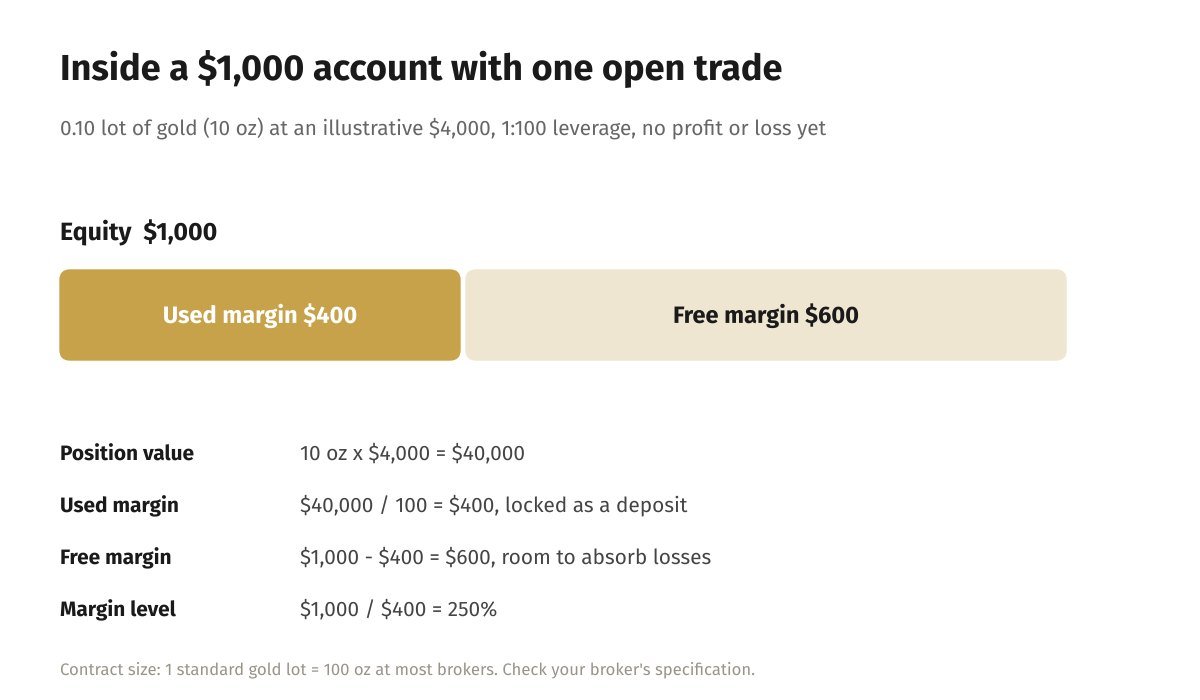
Say you buy 0.10 lot of gold at $4,000. One standard gold lot is usually 100 ounces, so you control 10 ounces worth $40,000. At 1:100 leverage the broker locks $400 as margin. The other $600 in a $1,000 account stays free.
Required margin = (lots x contract size x price) / leverage
The five numbers on your MT5 terminal
| Term | What it means | Formula |
|---|---|---|
| Balance | Your account money, not counting open trades | Deposits + closed profit – closed losses |
| Equity | What your account is worth right now | Balance + open profit or loss |
| Used margin | Money locked as a deposit for open trades | Position value / leverage |
| Free margin | Money available to absorb losses or open new trades | Equity – used margin |
| Margin level | Your safety gauge. Brokers act on this number | Equity / used margin x 100% |
What is leverage?
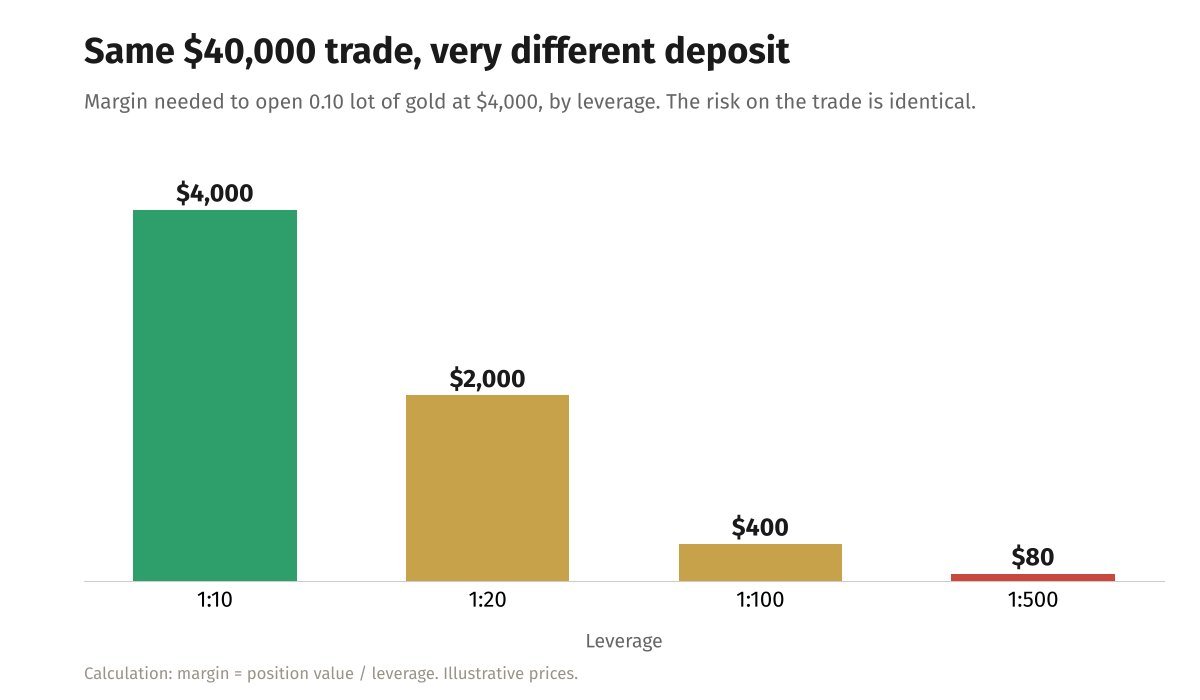
Leverage is the ratio between the size of your position and the margin you put up. At 1:100, every $1 of margin controls $100 of the market. Leverage and margin are two sides of the same number: 1:100 leverage means a 1% margin requirement.
The key point most beginners miss: higher leverage only lowers the deposit. It does not change how much you make or lose per dollar the price moves. That depends only on your position size.
The danger is that a smaller deposit makes it easy to open a position far too big for your account.
| Leverage | Margin as % of position | Where you see it |
|---|---|---|
| 1:2 | 50% | Cryptocurrencies (retail, Europe) |
| 1:10 | 10% | Other commodities |
| 1:20 | 5% | Gold, major indices (retail, Europe) |
| 1:30 | 3.33% | Major currency pairs (retail, Europe) |
| 1:100 | 1% | Common at offshore brokers |
| 1:500 | 0.2% | Very high, offshore only |
Leverage cuts both ways
Same $1,000 account, same 0.10 lot of gold. Every $1 move in gold is worth $10 to you.
Gold rises $50
+$500
A 1.25% move in gold becomes a +50% gain on your account.
Gold falls $50
-$500
The same 1.25% move against you wipes out half your account.
Effective leverage: the number that really matters
Your broker may offer 1:500, but the leverage you are actually using is your total position value divided by your equity. In the example: $40,000 / $1,000 = 40:1 effective leverage, whatever the account setting says.
Effective leverage = total position value / equity
Many experienced traders keep effective leverage low, often in single digits, so normal price swings can’t threaten the account. Pair this with a fixed risk per trade, as explained in Why Most Retail Traders Lose Money.
Margin calls and stop outs
A margin call is your broker telling you that your equity no longer comfortably covers the margin on your open trades. A stop out is what happens if you do nothing and losses keep growing: the broker closes your trades for you.
- Price moves against you, so your open loss grows and your equity falls.
- Your margin level (equity / used margin) drops with it.
- At the broker’s margin call level (often 100%), you get a warning and usually can’t open new trades.
- If losses continue to the stop-out level (often 20-50%), the broker starts closing your positions automatically, biggest loser first, at whatever price is available.
- The loss is now realised. You don’t get the chance to wait for a recovery.
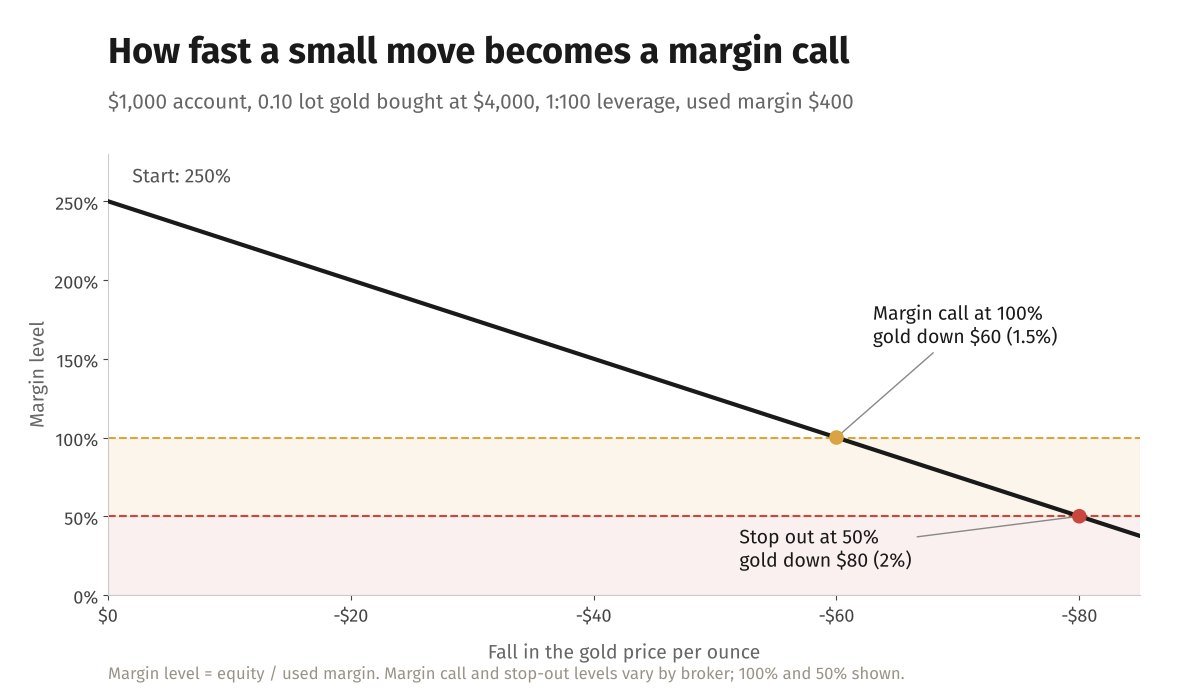
In our example, a $60 drop in gold, about 1.5%, triggers the margin call. An $80 drop, about 2%, stops the trade out. Gold can move that much in a single session, especially around major news.
| Margin call | Stop out | |
|---|---|---|
| What triggers it | Margin level falls to the margin call level | Margin level falls to the stop-out level |
| Typical level | 100% (varies by broker) | 20-50%; 50% minimum for retail CFDs in Europe |
| What happens | Warning; new trades blocked | Positions closed automatically |
| Can you still act? | Yes: add funds or reduce positions | No: the broker acts for you |
Leverage limits set by regulators
Regulators cap leverage for retail traders because high leverage and fast losses go together. Under ESMA’s rules for CFDs in Europe, retail clients get these maximums, plus a margin close-out at 50% of required margin and negative balance protection, so you can’t lose more than your account.
| Underlying | Maximum leverage for retail clients |
|---|---|
| Major currency pairs | 30:1 |
| Non-major currency pairs, gold, major indices | 20:1 |
| Other commodities, non-major indices | 10:1 |
| Individual shares | 5:1 |
| Cryptocurrencies | 2:1 |
Brokers in other regions may offer 1:500 or more. Treat that as a reason for extra caution, not a feature. It mainly lets you open positions that are too large. Also check that trading these products is permitted where you live.
Margin calculator
Enter your own numbers to see the margin you need, your effective leverage, and how far price can move against you before a margin call. Defaults match the gold example above.
How to avoid margin calls: 8 rules
Size from risk, not from margin
Decide the most you will lose (1-2% of equity), then size the position from your stop-loss distance.
Always use a stop loss
A stop loss closes the trade long before a margin call can.
Keep effective leverage low
Check total position value / equity before every trade, including all open positions.
Keep a free margin buffer
Never let used margin take most of your equity. Free margin is your shock absorber.
Respect news and weekend gaps
Prices can jump past stops at NFP, CPI or a Monday open. Reduce size or stay flat.
Watch EAs that stack trades
Grid and martingale EAs add positions as price moves against them, using up margin fast.
Know your broker’s levels
Find the margin call and stop-out levels in your account terms before you trade.
Check negative balance protection
Know whether you could owe more than your deposit after a big gap.
Frequently asked questions
Is margin a fee?
No. Margin is a deposit that your broker holds while a trade is open. It is released when you close the trade. Your costs are the spread, commission and overnight swap.
Is higher leverage riskier?
Higher leverage itself only lowers the margin you need. The risk comes from the bigger positions it allows. A small position on a 1:500 account carries the same risk as on a 1:20 account, but 1:500 makes oversized trades much easier to open.
What should I do when I get a margin call?
Reduce or close losing positions, or add funds if your plan allows it. Better still, size trades so you never get close: a stop loss should close a trade long before a margin call.
Can I lose more than my deposit?
It depends on your broker and region. Retail CFD clients in Europe get negative balance protection. Elsewhere, a large price gap could leave a negative balance, so check your broker’s terms.
What leverage should a beginner use?
The account setting matters less than position size. Keep effective leverage low and risk no more than 1-2% of your account per trade.
How do I calculate the margin for a trade?
Multiply lots by contract size by price, then divide by your leverage. For 0.10 lot of gold at $4,000 with 1:100 leverage: 0.10 x 100 x 4,000 / 100 = $400.
Conclusion: control your size, and margin takes care of itself
Margin is a deposit. Leverage is a ratio. A margin call is a warning, and a stop out is the broker closing your trades for you. None of them is dangerous on its own. What makes them dangerous is a position that is too large for the account.
Size every trade from your risk, use a stop loss, keep effective leverage low and leave plenty of free margin. Do that, and you should rarely, if ever, see a margin call.
Let rules manage the risk
Trade Like Sukrit EAs apply a fixed lot size and stop loss to every gold and Bitcoin trade, with their logic and verified results shown openly.
Sources
Gold prices in the examples are illustrative. Contract sizes, margin call and stop-out levels vary by broker.
Risk disclaimer: Trading forex, gold, cryptocurrencies, CFDs and other leveraged products involves significant risk and may not be suitable for all investors. Leverage magnifies both gains and losses, and you can lose some or all of your capital. Past performance does not guarantee future results. This article is for educational purposes only and is not investment advice. Check that trading these instruments is permitted in your country before you start.